06AI / Satellite / Marine
Satellite-Based Marine Oil Spill Detection
A maritime investigation console that finds oil spills in satellite radar imagery and works back towards the vessels that could be responsible.
On attributionSmart India Hackathon projects are built in teams. This page describes the application we deployed, not a claim that every part of it is mine alone.
01 Overview: Seeing a spill, then asking where it came from
Built for Smart India Hackathon 2026, this is a satellite-based application for identifying and monitoring oil spills at sea.
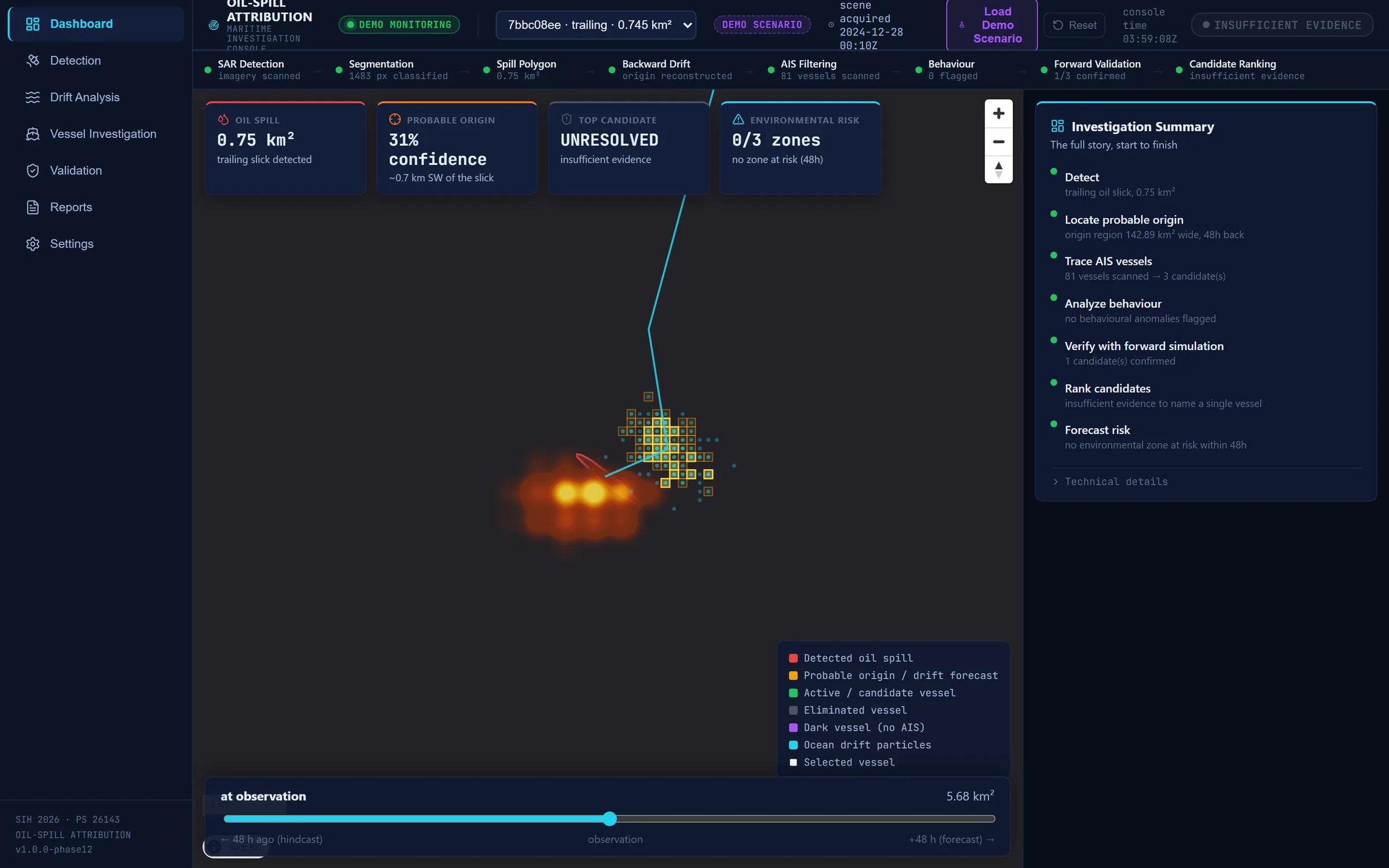
The deployed console, titled Oil-Spill Attribution, maps a slick detected in SAR (radar) imagery, reconstructs where it may have come from, and checks nearby vessel traffic against that evidence.
02 Problem: Spills are hard to see, and harder to attribute
An oil spill in open water can be invisible from the shore. Satellite radar can reveal a slick, but monitoring how it moves, and which vessel may be responsible, is a much harder question.
03 The Platform: What the live console does
- Detects and segments the slick from SAR imagery and turns it into a spill polygon on an interactive map.
- Runs backward drift analysis (hindcast) to estimate a probable origin region.
- Filters AIS vessel traffic near the spill, and flags “dark vessels”: ships seen by radar with no matching AIS report.
- Analyses vessel behaviour, validates candidates with forward simulation, and ranks suspects.
- Forecasts where the spill could drift next, and exports investigation reports, including KML.
04 Technical Approach: An evidence pipeline, stage by stage
- 01SAR detectionRadar imagery is scanned for a slick.
- 02SegmentationPixels are classified to outline the spill.
- 03Spill polygonThe outline becomes a mapped polygon.
- 04Backward driftThe probable origin is reconstructed.
- 05AIS filteringVessels active near the origin are narrowed down.
- 06BehaviourCandidate vessels are checked for anomalies.
- 07Forward validationSimulations test each candidate against the slick.
- 08RankingCandidates are ordered by the evidence.
The frontend is a React map console built on MapLibre GL, which talks to a separate backend API. Both are deployed on Render.
Built with
- React
- MapLibre GL
- TanStack Query
- REST API
- Render
Section: mathan/lets-talk
Have a project, internship or opportunity in mind?
I’m open to internships and to AI, computer-vision and full-stack work. The quickest way to reach me is below.